


‘We Work To Survive’: Poverty Drives Children Into Mining In DR Congo
- by RNG247 Reporter
- about 6 months ago
- 494 views
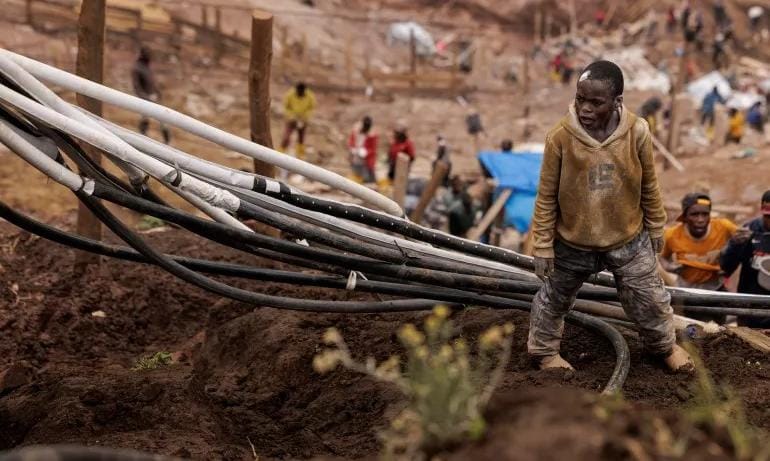
Rubaya, Democratic Republic of the Congo – Just weeks after a devastating mine collapse killed hundreds in the eastern town of Rubaya, heavy rains struck again, triggering another deadly landslide as unstable mine slopes gave way.
Following the March 3 disaster, authorities reported that about 200 people died at the Kasasa mining site, including at least 70 children. Most of them were working in informal, small-scale mining operations in the mineral-rich region.
Fifteen-year-old Mishiki Nshokano* survived the tragedy.
Now recovering in Goma, about 60km away, he avoids thinking about the trauma and the friends he lost. Still, he says he has little choice but to return to the mines soon.
“I have no other option,” he says.
Rubaya, located in North Kivu province, sits on large deposits of coltan, tin, and tungsten—valuable minerals widely used in modern technology like smartphones and electric vehicles.
Yet many of the miners extracting these resources, especially children, say they are unaware of their global importance. Their focus is simply earning enough to survive each day.
Nshokano, the eldest of three siblings, has worked in the mines for four years to support his family. Although child labour is illegal in the country, much of the mining sector operates informally and without regulation.
The situation is made worse by ongoing conflict in the region, where fighting between government forces and armed groups—particularly the Rwanda-backed M23—has destabilized communities. The group took control of Rubaya in 2024 and later captured key cities, including Goma.
“The little money I make, I give it to my mother,” Nshokano explains. “She uses it to help us survive.”
He remembers a different life growing up in nearby Luunje village, attending school in a clean uniform and dreaming of becoming a surgeon.
But everything changed in 2022 when his father, also a miner, died in a landslide at the Gakombe-Kalambairo site.
“My father struggled to pay for our schooling with what he earned. When he died, it shook the whole family,” Nshokano says.
“With mining being our only source of income, I had to leave school to support my family.”
Before his father’s death, conditions were still tough, but more manageable. His father earned around 25,000 francs (about $12) a day—three times what Nshokano now makes—by digging for coltan at unpredictable depths.
“Back then, things were better. We had food, a place to stay, and we could go to school,” he recalls. “After he died, everything fell apart.”
Despite the country’s vast mineral wealth, more than 70 percent of people in the Democratic Republic of the Congo live on less than $2.15 a day, according to the World Bank.



0 Comment(s)